

Map Mod: RPM – Rhineland & Palatinate 1:1 Map for ETS 2
![Writer: [Admin] Dustin B.](https://static.wixstatic.com/media/1bf8c6_d6ae6f8acd39482c9229cac10f0c22d6%7Emv2.jpg/v1/fill/w_32,h_32,al_c,q_80,enc_avif,quality_auto/1bf8c6_d6ae6f8acd39482c9229cac10f0c22d6%7Emv2.jpg)
Updated: 4 days ago
The Revolution of Realism: A Close Look at the
ETS 2 RPM 1:1 Map and the Indispensable
D.B Creation Ecosystem
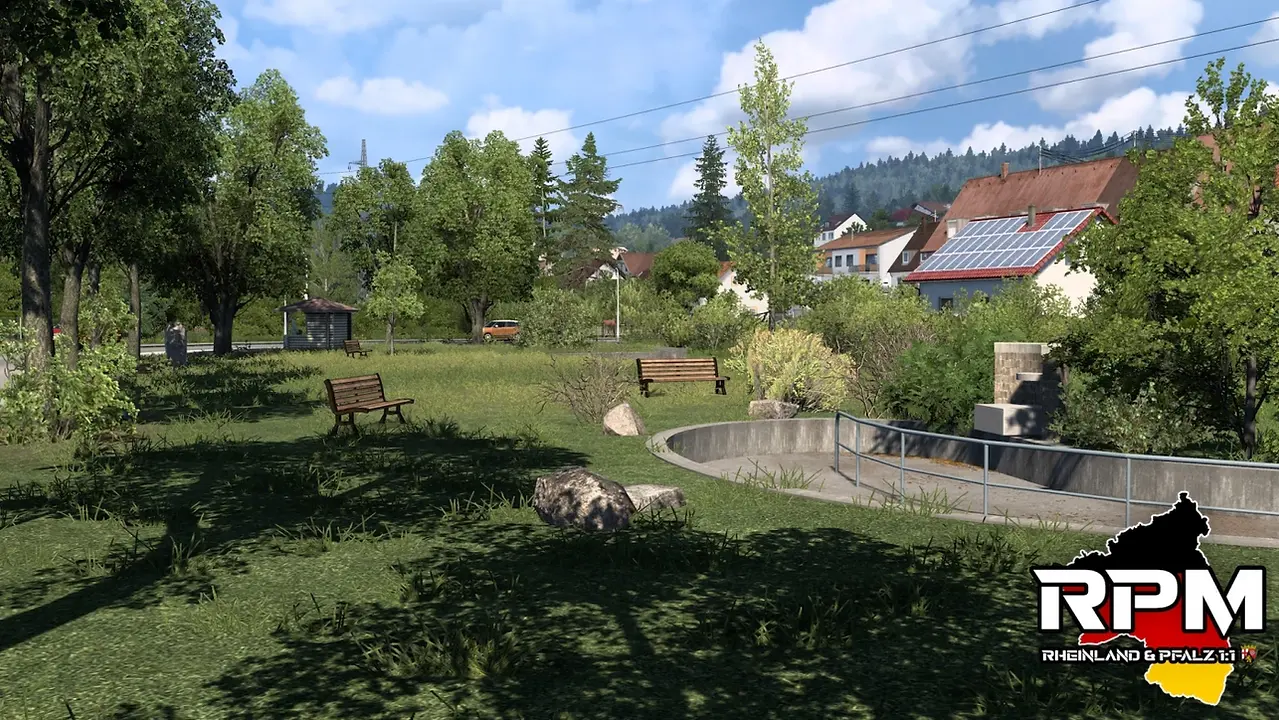
RPM 1:1 
RPM 1:1 
RPM 1:1 
RPM 1:1
I. Introduction: When 1:1 Meets Perfection
1.1 The Rise of the RPM Map: A New Benchmark
The Rhineland & Palatinate 1:1 Map (abbreviated RPM Map) has raised the standards for ETS 2 modifications to a new level since its release at the end of 2023. It quickly established itself as the "undisputed king of the 1:1 maps" in early 2024, which underlines its extraordinary attention to detail and the scale of the recreation. The map focuses on the south-west of Germany and reproduces its complex geography with unparalleled precision.
The key to the uniqueness of the RPM Map lies in its scale: unlike the SCS standard map, which mostly works at a scale of 1:15 to 1:19, RPM offers a true 1:1 representation. This means that every kilometre driven in the game corresponds to one real kilometre, including a realistic 1:1 time scale. This extreme realism has profound effects on the gameplay experience. Journeys that would take only a few minutes on the SCS map can take an hour or longer on the RPM Map. This fundamental shift in game dynamics demands a higher level of concentration and stamina from the player. At the same time, the simulation value rises exponentially, as the driving situations and the time component are authentically reflected.
1.2 RPM as a Standalone Vision and the Need for the Ecosystem
It is important to understand that the RPM Map is designed as a standalone map which is fundamentally incompatible with the SCS standard European map as well as with large geographical modifications such as ProMods. This isolation allows the developers to reproduce the Rhineland & Palatinate region exactly, without regard for the design conventions of the standard map.
Because of the extreme level of realism – in particular the narrow road widths and the demanding infrastructure – the standard AI of Euro Truck Simulator 2 (ETS 2) quickly reaches its limits. A highly detailed, physically correct world such as the RPM Map presents requires correspondingly realistic and intelligent traffic and environment simulations. This is where the ecosystem of D.B Creation mods comes in, providing essential corrections and extensions for the AI's driving behaviour and the environment details, in order to make the 1:1 experience practical and immersive in the first place.
II. The RPM Map (Rhineland & Palatinate): Realism in Its Purest Form
2.1 Core Features and Geographical Precision
The RPM Map offers more than just an enlarged game world; it delivers a micro-level attention to detail that is second to none. The developers placed great emphasis on the correct reproduction of road widths, which is reflected in features such as "Small Roads with real width". The map in the south-west of Germany offers a deliberately demanding driving experience, including realistic, winding roads and so-called "winding logging trails" (timber transport routes).
Particular attention is due to the loading points. The RPM Map integrates realistic companies with "real hard parking spots", whose level of difficulty is based on feedback from real, regional lorry drivers. This greatly increases the level of simulation, as manoeuvring skills are required under tight conditions. The map is constantly being expanded; for example, versions 1.2.1/1.2.3 implemented extensions of the A62 motorway to the north, the redesign of existing A62 sections with real road width, as well as the addition of the village of Bann, parts of Queidersbach and the K60 road. This continuous expansion demonstrates the ambition to create a living and geographically accurate image of the region.
2.2 Integration of AI and Game Dynamics
To complete the immersion in the 1:1 world, the RPM team integrates specific traffic elements and dynamic features. This includes expanding the AI traffic with regionally typical vehicles such as the Setra S531 DT double-decker bus as well as commercial vehicles such as Remondis refuse lorries and trucks with swap bodies. The addition of such locally specific AI models is not merely a cosmetic addition, but a direct attempt to faithfully replicate the
local atmosphere of Germany. On a 1:1 map, any lack of regional authenticity would quickly stand out and disturb the depth of the experience.
Furthermore, bus features were implemented that add the Setra bus to the map and enable corresponding bus and passenger routes (usable with an invisible trailer). New cargo types, such as a beet cleaner loader, and improved acoustic elements, including a realistic DB level crossing gong, further contribute to local authenticity and to the realism of transport.
III. System Requirements and ETS 2 DLC Dependencies
3.1 The Obligatory DLC Matrix
Although the RPM Map functions as a standalone module and represents a world of its own, it uses assets (3D models, textures and prefabs) from the official SCS Map DLCs. Without these DLCs, textures may be missing or the map may crash on loading. The developers are forced to use assets from all SCS expansions in order to guarantee the visual variety and the required level of detail of the 1:1 environment.
Accordingly, using the RPM Map (as of version 1.2.x/1.55) absolutely requires ownership of almost all major SCS Map DLCs:
DLC Category | Required DLCs | Purpose and Relevance |
European Expansions | Going East, Scandinavia, Vive la France, Italia, Beyond the Baltic Sea, Road to the Black Sea, Iberia, West Balkans | Provision of assets, textures and prefabs used for the detailed 1:1 map creation |
Special Content | Special Transport DLC | Absolutely essential for using the dedicated special transport routes on the RPM Map |
3.2 The Buffer Page Tweak: Stability Is King
The extreme level of detail of the 1:1 map and the additional load caused by traffic mods require technical adjustments to the game engine, as the standard configuration of ETS 2 is not designed for these volumes of data. The developers have explicitly pointed out that, in order to avoid crashes and performance problems, the buffer page size must be adjusted.
This adjustment is a critical step that transforms the use of the RPM Map from a simple mod installation into a profound system tweak. It signals that the map exceeds the limits of the standard engine.
Steps for adjusting the configuration:
Open the config.cfg file in the Documents\Euro Truck Simulator 2 directory.
Find the line uset r_buffer_page_size.
Change the default value "10" to at least "50" (sometimes "30" is also recommended).
Save and close the file. This measure ensures that enough memory is reserved for the high-resolution map data.
IV. Installation and Activation of the RPM Standalone Module
4.1 Sources and Version Management
The RPM Map should be obtained exclusively through official channels in order to guarantee the most up-to-date and stable version. These channels include the official RPM Modding website, the SCS forum and platforms such as TruckyMods. The map is under active development; the current version 1.2.3, for example, is compatible with ETS2 version 1.55.
4.2 Creating the Dedicated Profile
The RPM Map is a standalone map, which makes the creation of a new, dedicated game profile absolutely essential.
The critical step: When creating the new profile in the mod manager, the dedicated map module must be selected. For the RPM Map this is the module rpm.mbd (often referred to as "1:1 scale maps"). If this step is omitted, the map cannot be loaded correctly. Optionally, players can activate a QuickStart mod to increase the starting capital to 15 million and raise the XP level, which immediately unlocks truck dealers and cargo categories.
4.3 The RPM Internal Load Order
The RPM files themselves consist of several components (assets, models, map def, special transport) that must follow a specific load hierarchy in the mod manager in order to interact correctly.
The following order must be observed within the RPM files (from bottom to top, lowest priority first). This hierarchy is an architectural necessity. Models and textures form the visual foundation (lowest priority), while the map definitions and special routes override this base in order to define the playable world (highest priority).
Table Title: Specific Load Order of the RPM Map Files (From Bottom to Top)
Priority (Top) | Module Type | Function |
1 (Highest) | RPM Special Transport DLC | Contains the definitions of the new special transport route |
2 | RPM Map File | The main map definition and logic |
3 | RPM Prefab | Pre-made objects and complex structures |
4 | RPM Assets | General assets, textures, sound definitions |
5 (Lowest) | RPM Models 1/2 | The 3D models and basic visual components |
V. The Synergy Effect: D.B Creation Mods as an Immersion Upgrade
5.1 The Need for Traffic Realism
Driving on the deliberately realistic, narrow and winding 1:1 roads of the RPM Map quickly becomes frustrating when the simple AI of the standard game is used. The standard AI is unable to react appropriately to the subtle, real road widths and the complex geometries (such as the demanding timber transport routes, for example). The D.B Creation mods fill this critical gap by comprehensively revising not only the density but above all the
behaviour of the AI traffic.
5.2 D.B Creation Traffic Intensity Mod: The Core of the Added Value
The Traffic Intensity Mod from D.B Creation is the most important building block for the 1:1 experience. It increases the spawn frequency in order to simulate more realistic traffic volumes, and implements defined rush hours ("Rush Hour") at 8 a.m. and 3 p.m.
The mod goes far beyond a mere increase in density. It adapts the AI behaviour at critical points, including roundabouts, junctions and motorway slip roads. The modification of the "Swing Radius of AI Long Trailers in Curves" is a technical proof of the mod's necessity on 1:1 maps. Without this adjustment, long AI trailers would constantly collide in the narrow, realistic curves of the RPM Map or block the traffic, which would make the driving experience unplayable. D.B Creation also improves overtaking manoeuvres, accident recovery and safety distances (AI Safety Parameters). To avoid congestion despite the increased traffic, the traffic light cycles have also been revised.
5.3 D.B Creation Real Environment Mods: Visual and Acoustic Fine-Tuning
In addition to traffic flow, other D.B Creation mods (such as Real Weather or Xenon Lights) provide visual and physical improvements that harmonise perfectly with the depth of detail of the RPM Map.
The environment mods complement the RPM visuals with:
Infrastructure harmonisation: Revised prefabs, better visibility of traffic signs and more realistic lighting in tunnels and at service areas.
Realistic level crossings: Level crossings receive reflective barriers and new signalling technology. Important is the introduction of a recommended reduced speed of 30 km/h, due to the changed road surface, which increases realism in dealing with the infrastructure.
Weather and visuals: The mod package often includes improved loading screens, more detailed light cones (Xenon Lights), as well as new rain particles and an increased number of raindrops, which considerably enhances the atmosphere in bad weather on the 1:1 roads.
VI. Compatibility in the Ecosystem: D.B Creation and Map Combinations
6.1 Choosing the D.B Traffic Variant
For the seamless integration of D.B Creation and the RPM Map, the correct mod variant of the Traffic Intensity Mod must be chosen: as RPM uses a standalone map module, the "Costum Variant" of the D.B Traffic Intensity Mod must be activated. The "SCS Map Variant" is intended exclusively for profiles without map mods. The Custom Variant ensures that the revised AI rules can be applied to the RPM module.
6.2 The Golden Rule of the Load Order
The most critical step for the stability and correct functioning of the mods is compliance with the load hierarchy in the mod manager. This follows the basic principle that global definition files must override the asset files.
The D.B Creation mods (which globally define the AI behaviour, the physics and the weather) must ALWAYS be loaded above the actual map files (map, assets, prefab) in the mod manager. If the RPM Map files were loaded higher up, their potentially included generic definitions would render the complex, realistic AI rules of D.B Creation ineffective, which would lead to faulty traffic on the 1:1 roads.
The expert load order (from top to bottom, highest priority first) is to be set up as follows:
Table Title: Expert Load Order for RPM and D.B Creation (From Top to Bottom)
Priority | Mod Category | Example (D.B Mod) | Function |
Highest | Traffic AI Definition | D.B Creation Traffic AI Mod (Costum Map Variant) | Defines the entire AI behaviour and the density |
High | Vehicle definitions | D.B Creation Vehicle Definitions, D.B Real Physics, D.B Real Weather | Global environment and chassis improvements |
Medium | Map connectors | RPM x Heilbronn Fix / RPM x Real Poland RC | Enables several standalone maps to work together |
Low | RPM Map files (observe the internal order) | RPM Map, RPM Assets, RPM Models | The physical game world and its visual assets |
D.B Creation Premium Package – all mods in one package

D.B Creation Premium Package – all ETS 2 mods for €20
Seven mods bought individually cost €24.50 – in the Premium Package you get them all together for €20. Plus exclusive VIP mods, instant download, no 60-minute queue, ad-free and all future updates included.
Note: We do not host third-party mods ourselves — those files come from their respective creators or other external services. The rights holders are responsible for content, availability and updates; we only link to them.
6.3 Advanced Map Combinations
For hardcore simulation enthusiasts, the RPM Map also offers compatibility with other 1:1 maps. The RPM Map is compatible with the Heilbronn Map (from RPM V1.1.2 and Heilbronn V1.1.5). However, this requires a separate compatibility fix, which in the load order above the RPM and Heilbronn files must be placed. Likewise, RPM can be combined with the Real Poland 1:1 Map, for which a special
RPM x Real Poland Connector (e.g. V 1.2 RC) is required.
VII. Conclusion and Outlook
The RPM 1:1 Map in combination with the D.B Creation ecosystem represents the most realistic and demanding driving experience currently available in Euro Truck Simulator 2 today. The attention to detail of the Rhineland-Palatinate region, from narrow alleys to realistic loading points, only truly becomes usable through the D.B Creation mod. Adapting the AI behaviour and dynamically controlling traffic density are functional necessities for mastering the extreme demands of the 1:1 geometry.
However, players who strive for this degree of immersion must be aware of the technical requirements. The effort of owning all DLCs, adjusting the config.cfg and strictly adhering to the load hierarchy is the price for the level of simulation on offer. The active and continuous further development by the RPM team (most recently through extensions such as Bann and the expansion of the A62 in version 1.2.3) secures the longevity of this modification. The synergy between RPM's physical precision and D.B Creation's dynamic improvements points the way for future, highly detailed simulations in the ETS 2 community.
Download